

How we developed an engagement campaign around psychological safety
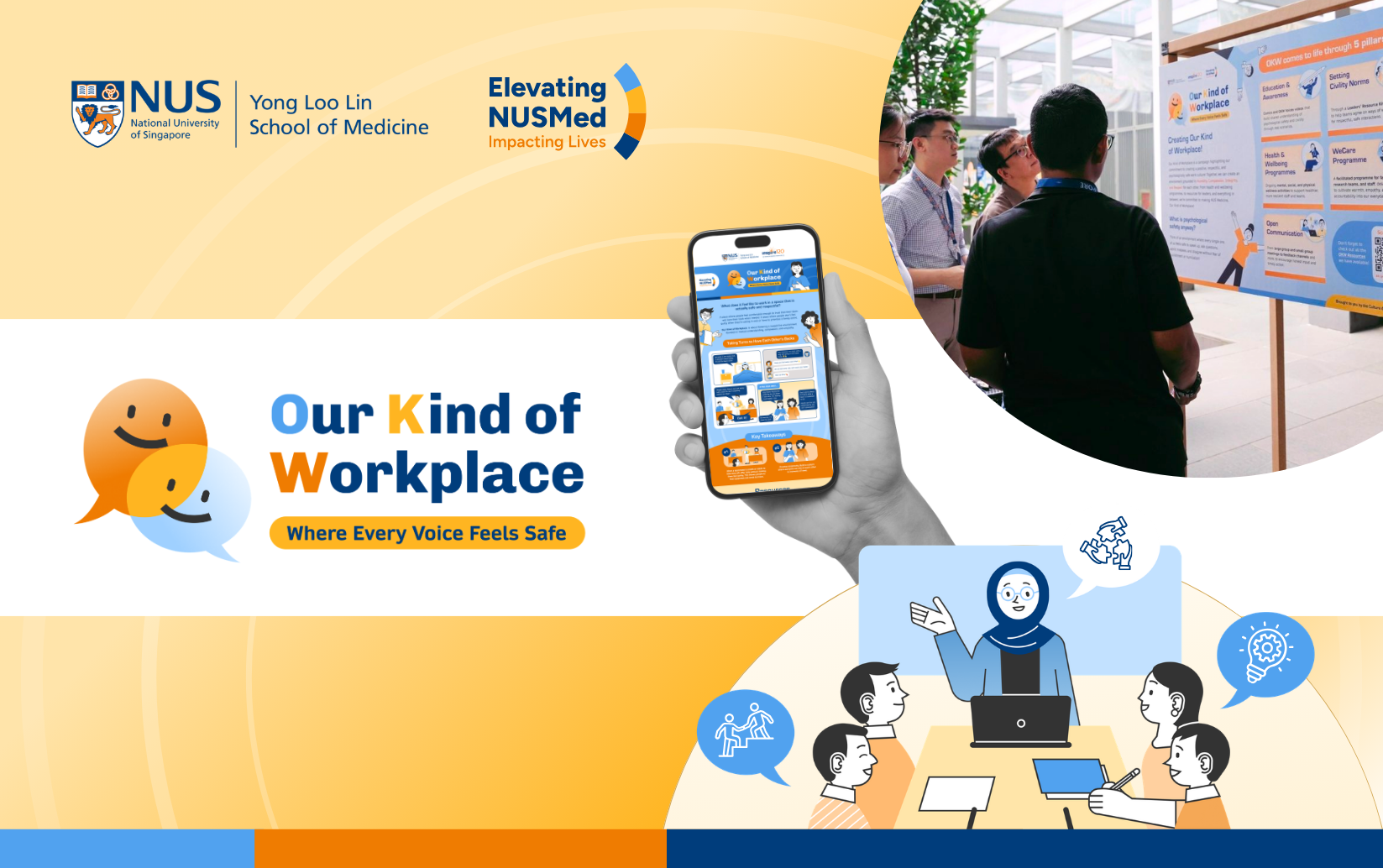
As mental health becomes more present in the cultural zeitgeist, creating psychologically safe workplaces has become more and more important. For NUS Medicine, this took the form of the Our Kind of Workplace (OKW) initiative.
The mission
Our Starting Point
The project aimed to strengthen psychological safety and promote a culture of civility within NUS Medicine. While policies and guidelines provided the foundation, they found that creating meaningful behavioural change requires staff and faculty to understand, experience, and practise respectful behaviours in their everyday interactions.
They recognised that psychological safety cannot simply be mandated through top-down communications. Instead, it required sustained engagement through relatable conversations, shared experiences, and practical resources that encourage reflection and action. Brain Juice Collective (BJC) was engaged to develop a strategic communications approach to translate these complex cultural concepts into an accessible, community-driven campaign that resonated with employees across roles, from education and administration staff to researchers and faculty members.
We were engaged as both a strategic communications consultant and a creative partner to conceptualise and implement an internal engagement campaign centred on psychological safety and civility.
Our role extended beyond producing communication materials. We were tasked with understanding staff perspectives, uncovering authentic workplace experiences, and developing a campaign that reflected the realities of the NUS Medicine community.
This included everything from:
- Project management and strategic consultancy
- Review of existing materials and data
- Facilitation of a focus group discussion (FGD) with their staff
- Analysis and synthesis of qualitative findings
- Development of illustrated comic episodes
- Creation of a supporting resource guide
- Development of four campaign comic EDMs to reinforce campaign messages and practical workplace tips
The Brain Juice Approach
The BJC Shift
We designed the initiative around authentic community voices. Putting the community at the centre of the campaign.
The campaign began with qualitative research through a focus group discussion to uncover genuine workplace experiences, concerns, and examples of positive and challenging interactions. These insights became the foundation of the campaign, ensuring that the messaging reflected situations that staff could immediately recognise.
A key strategic decision was to communicate through illustrated comic storytelling. Comics provide a safe, approachable way to discuss sensitive workplace topics without appearing overly instructional or punitive. They allow the staff to reflect on behaviours through familiar scenarios while reducing defensiveness.
The campaign was further supported by EDMs and practical resource guides that translated each story into actionable tips, helping staff move beyond awareness towards everyday behavioural change.
Overall, the strategy focused on making psychological safety tangible, relatable, and easy to discuss across the NUS Medicine community.
Our Role
What We Did
Phase 1 of OKW was made up of 3 main items:
1. Focus Group Discussion (FGD)
- Designed and facilitated a staff focus group. To gather authentic workplace experiences and perspectives.
- Synthesised findings into an insights presentation.
- Behavioural change campaigns are more credible when built on lived experiences rather than assumptions. The FGD ensured the campaign reflected the voices of the NUS Medicine community.
2. Comic EDM Series
- Developed four workplace comic episodes based on real scenarios.
- Produced storyboards, illustrations, and final artwork.
- Storytelling enables staff to recognise behaviours in context, encouraging reflection without assigning blame. Comics are engaging, memorable, and accessible across diverse staff groups.
3. Resource Guide
- Produced an accompanying EDM with practical guidance and support resources.
- Provided staff with clear actions, support channels, and practical techniques for daily interactions.
Our impact
Keeping this On Our Radar
BJC runs our projects and programmes through our Responsible Innovation Framework: RADAr. The framework allows us to ensure that we’re creating solutions for partners that are sustainable and effective. The framework goes like this: Reflect - how we review our activities, commitments and processes to understand who is currently affected by our actions, both negatively and positively, Anticipate - how we anticipate the potential impacts of our product and develop strategies to cope with uncertainties, Diversify - how we actively involve a diverse, broad range of voices and values through participation, deliberation, and accountability, And Adapt & Respond: How did you adjust to challenges and perspectives so we can account for the unique contributions of different communities?
Reflect
The project began by reviewing existing HWB research and facilitating a focus group discussion to better understand staff experiences. Rather than assuming workplace challenges, the campaign was grounded in real stories and perspectives gathered directly from the community.
Anticipate
Recognising that psychological safety is a sensitive topic, BJC anticipated that traditional awareness messaging might feel overly formal or judgmental. We therefore adopted storytelling and humour through comics to encourage engagement while reducing defensiveness.
Diversify
The focus group brought together diverse perspectives across the NUS Medicine community, ensuring that the campaign reflected different roles, experiences, and viewpoints. Community voices directly informed the scenarios featured throughout the campaign.
Adapt & Respond
Insights gathered from the FGD informed the campaign direction, allowing messaging, scenarios, and supporting resources to evolve based on participant feedback. This iterative process ensured the final campaign remained authentic and relevant to staff experiences.
Ripples & Results
Qualitative
1. Increased awareness of psychological safety through relatable workplace scenarios.
Prompt: When you think of a respectful and psychologically safe workplace, what comes to mind?
Flexibility & Voice - “In a meeting, it is important for everyone to have right to talk (whether they are junior/senior)”.
Understanding & Empathy - “Sometimes you need to understand the problems the staff face and from there you'll know how to help him/her. Seeing things to their perspective.”
Transparency & Clarity - “Information should be flowing honestly, we are an organisation, complex in a way - it's important for us to know why it's happening, why decisions are made.”
Prompt: Share an example you’ve seen - a moment that made you or someone else feel respected or supported?
Supportive Leadership & Humanity - “We know what you’re doing, take care of your family, we understand and support you.” They support me and this makes me want to contribute even more”
Implementation of Feedback - "When I bring my feedback to RO, they were open to discussion and receptive of my opinions. I feel encouraged because they made me feel listened and appreciated.
Prompt: What would help you or your colleagues feel more respected and safe at work?
Create a meaningful reporting channel - "Emphasise on creating a channel that can really address it, not only just collecting reports"
Prompt: If a manager or team leader wanted to start a conversation on civility or safety, what would make that conversation feel natural and not awkward?
Keep it simple and straightforward - "Speak honestly about what’s happening without sugarcoating or over-explaining"
2. Created opportunities for staff to reflect on everyday behaviours and interactions.
3. Encouraged conversations around civility using a non-threatening and engaging format.
Quantitative
- Facilitated 1 Focus Group Discussion with 12 participants representing Senior Executives, Junior Executives, and Administrative & Research staff.
- Conducted a 75-minute facilitated discussion to uncover authentic workplace experiences, perceptions of respect and psychological safety, and ideas for improvement.
- Produced 4 original comics, 4 EDMs, and 1 curated resource guide grounded in staff experiences.
- Over the first five months, the campaign generated 1,999 clicks across 10 curated wellbeing and support resources featured in the EDMs, indicating sustained engagement with services such as HR Business Partners, Coaching, Anonymous Feedback channels, mindlineSG, Intellect, and Health & Wellbeing resources.
Reflections
“This project reinforced the importance of listening before communicating. By grounding the campaign in real community voices, psychological safety became less of an abstract organisational concept and more of an everyday practice that staff could understand, relate to, and apply.”
- Marguerit Francisco, Senior Portfolio Executive
Photo gallery

More reads for you
.png)

.png)


Forget the Trade-off
Subscribe for inspiration and insights on doing well while doing good. No spam, we promise!